Electrical Engineering - Teaching Lab Equipment

The Sangari ET series is a modular electrical-engineering training platform built around virtual instrumentation. The ET300 base system - a measurement interface with a full suite of virtual instruments (oscilloscope, spectrum analyzer, Bode plotter, function generator, adjustable three-phase supply) plus experimenter modules that accept plug-in experiment cards - hosts a family of course packages, each pairing hands-on experiment cards with guided multimedia courseware. The courses cover three-phase systems, measurements with the multimeter, electrical network analysis, and sensor measurement technology for non-electrical quantities: temperature, pressure and force, and displacement, angle and rotational speed. Every experiment runs at safety extra-low voltage, faults can be switched in by relay for diagnosis exercises, and all measured data is acquired, plotted and evaluated on the PC - one workstation carries an entire electrical-engineering lab curriculum.
6 experiments in Electrical Engineering

All categories →
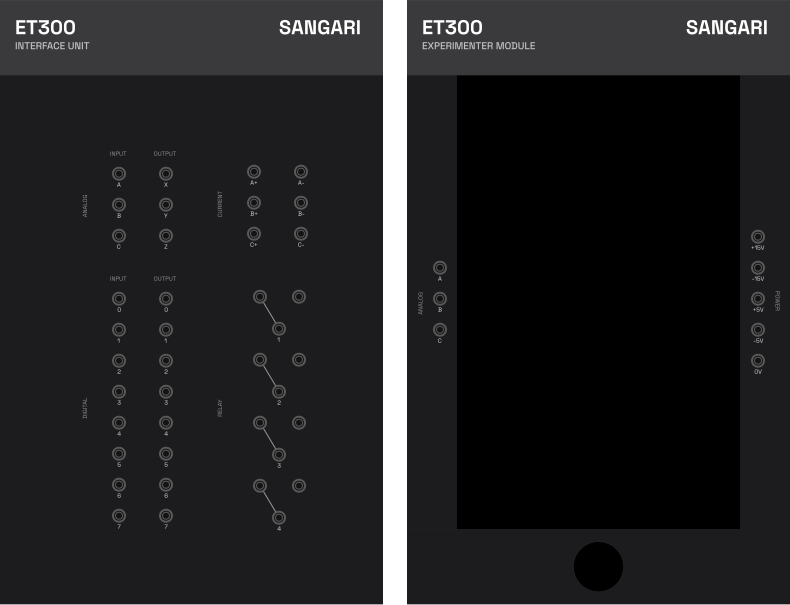
ET300
Virtual Instrumentation Base System

The measurement and instrumentation core of the Sangari ET modular training platform: a PC-controlled interface with a full suite of virtual instruments, two experimenter modules that host the plug-in experiment cards of the ET course family, and a complete measurement accessory set. Central measurement interface with a complete suite of virtual instruments operated from the PC 2/4-channel virtual oscilloscope - 10 MHz bandwidth, 100 MS/s sampling Virtual voltmeters and ammeters for DC and AC, TrueRMS Spectrum analyzer, Bode plotter, function and arbitrary generators Adjustable DC and three-phase supply, variable up to 150 Hz 16-bit digital I/O and 8 switching relays for fault-simulation exercises Experimenter modules accept plug-in experiment cards for the whole ET course family USB and WLAN connection to the PC; all experiments at safety extra-low voltage

Open
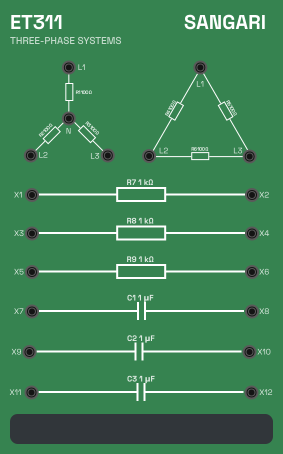
ET311
Three-Phase Systems

A course package for the ET platform: real star and delta circuits with resistive and capacitive loads, powered by an adjustable three-phase supply at safety extra-low voltage, with guided multimedia courseware for the study of three-phase networks. Terminology and applications of three-phase systems Measurement of phase and line voltages and currents in three-phase networks Experimental verification of the laws relating phase and line voltages Resistive and capacitive loads in star and delta connection Phase shift between phase voltages - phasor representation Compensating currents in the neutral conductor and the effect of a broken neutral Current and voltage measurements for balanced and unbalanced loads Power measurement on a three-phase load

Open
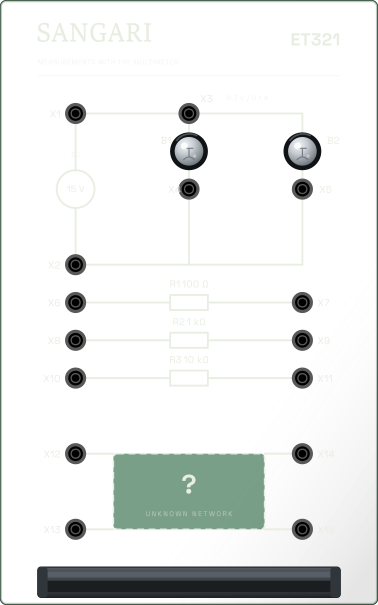
ET321 experiment card
ET321
Measurements with the Multimeter
Open
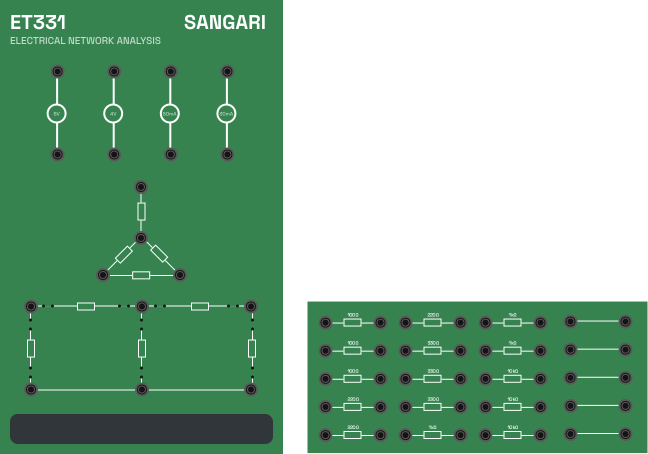
ET331
Electrical Network Analysis

A course package for building real resistor networks on a freely configurable connector panel - with integrated current and voltage sources - and verifying the classical theorems of circuit analysis by measurement. Kirchhoff's current and voltage laws applied to resistor networks The superposition theorem for networks with multiple sources Thévenin and Norton equivalent circuits and their equivalence Millman's theorem for parallel sources Star–delta transformation The mesh-current and node-voltage analysis methods Power matching between source and load

Open
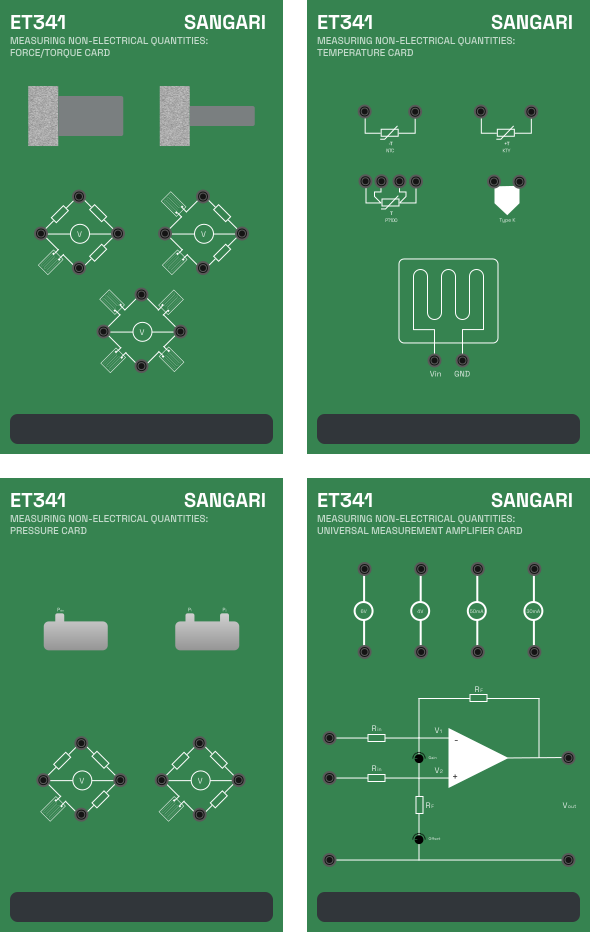
ET341
Measuring Non-Electrical Quantities: T/P/F

A course package on sensors and signal conditioning for non-electrical quantities - temperature, pressure, force and torque - measured with four experiment cards, configurable bridge circuits and a universal instrumentation amplifier. Calibration of the instrumentation amplifier Circuits for temperature measurement - sources of error and linearization of the Wheatstone bridge Principles and characteristic curves of Pt100, NTC, KTY and thermocouple sensors Piezoelectric, inductive and resistive pressure measurement principles Recording the characteristics of absolute and differential pressure sensors Force measurement with strain gauges on a bending bar Torque measurement with strain gauges on a torsion rod Effect of the measuring circuit - full, half and quarter bridge configurations Static characteristics and measurement errors: sensitivity, linearity, hysteresis, repeatability

Open
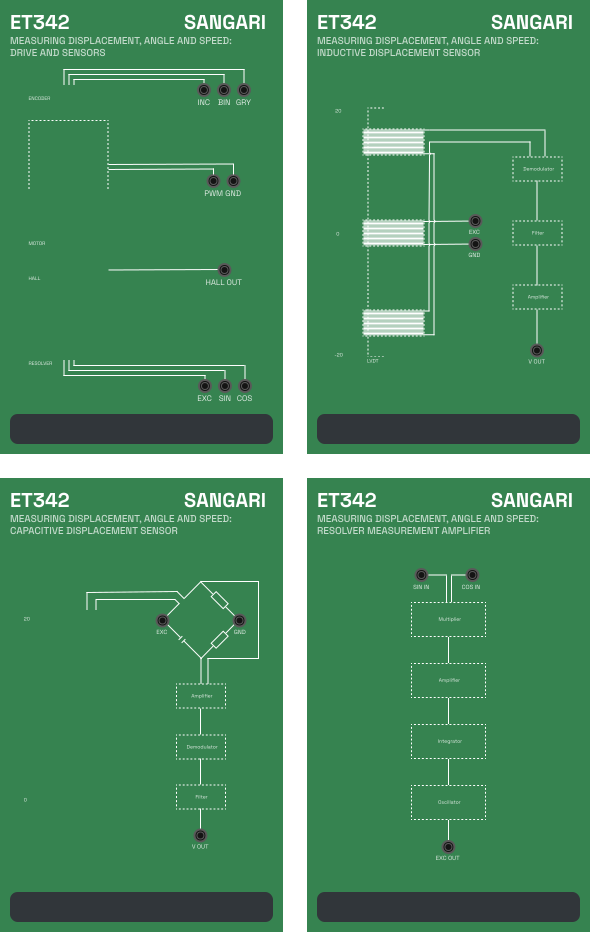
ET342
Measuring Displacement, Angle and Speed

A course package on the sensors that measure linear displacement, angular position and rotational speed - LVDT and capacitive probes, optical encoders, Hall sensors and resolvers - driven by a controllable reference drive and evaluated by analog and digital methods. Analog and digital methods for measuring displacement, angle and speed Design and calibration of inductive (LVDT) displacement sensors - characteristic curves Capacitive displacement measurement with an AC measuring circuit Optical encoders for shaft position - incremental, binary and Gray code Position and speed measurement of rotating shafts with Hall sensors Rotational speed determination by pulse counting The resolver principle - amplifier calibration and recording of position characteristics Comparison of sensor types for the same physical quantity; resolution, repeatability and linearity errors

Open

Curated packages

Package

Electrical Engineering Training System

A modular electrical-engineering training platform built around virtual instrumentation. The ET300 base system hosts a family of course modules covering three-phase systems, multimeter measurement, network analysis, and sensor measurement technology for non-electrical quantities.

Package details →
ET300 Electrical Engineering Training System
Virtual Instrumentation Base System

The measurement and instrumentation core of the Sangari ET modular training platform: a PC-controlled interface with a full suite of virtual instruments, two experimenter modules that host the plug-in experiment cards of the ET course family, and a complete measurement accessory set. Central measurement interface with a complete suite of virtual instruments operated from the PC 2/4-channel virtual oscilloscope - 10 MHz bandwidth, 100 MS/s sampling Virtual voltmeters and ammeters for DC and AC, TrueRMS Spectrum analyzer, Bode plotter, function and arbitrary generators Adjustable DC and three-phase supply, variable up to 150 Hz 16-bit digital I/O and 8 switching relays for fault-simulation exercises Experimenter modules accept plug-in experiment cards for the whole ET course family USB and WLAN connection to the PC; all experiments at safety extra-low voltage

Open
ET311 Electrical Engineering Training System
Three-Phase Systems

A course package for the ET platform: real star and delta circuits with resistive and capacitive loads, powered by an adjustable three-phase supply at safety extra-low voltage, with guided multimedia courseware for the study of three-phase networks. Terminology and applications of three-phase systems Measurement of phase and line voltages and currents in three-phase networks Experimental verification of the laws relating phase and line voltages Resistive and capacitive loads in star and delta connection Phase shift between phase voltages - phasor representation Compensating currents in the neutral conductor and the effect of a broken neutral Current and voltage measurements for balanced and unbalanced loads Power measurement on a three-phase load

Open
ET321 experiment card
ET321 Electrical Engineering Training System
Measurements with the Multimeter
Open
ET331 Electrical Engineering Training System
Electrical Network Analysis

A course package for building real resistor networks on a freely configurable connector panel - with integrated current and voltage sources - and verifying the classical theorems of circuit analysis by measurement. Kirchhoff's current and voltage laws applied to resistor networks The superposition theorem for networks with multiple sources Thévenin and Norton equivalent circuits and their equivalence Millman's theorem for parallel sources Star–delta transformation The mesh-current and node-voltage analysis methods Power matching between source and load

Open
ET341 Electrical Engineering Training System
Measuring Non-Electrical Quantities: T/P/F

A course package on sensors and signal conditioning for non-electrical quantities - temperature, pressure, force and torque - measured with four experiment cards, configurable bridge circuits and a universal instrumentation amplifier. Calibration of the instrumentation amplifier Circuits for temperature measurement - sources of error and linearization of the Wheatstone bridge Principles and characteristic curves of Pt100, NTC, KTY and thermocouple sensors Piezoelectric, inductive and resistive pressure measurement principles Recording the characteristics of absolute and differential pressure sensors Force measurement with strain gauges on a bending bar Torque measurement with strain gauges on a torsion rod Effect of the measuring circuit - full, half and quarter bridge configurations Static characteristics and measurement errors: sensitivity, linearity, hysteresis, repeatability

Open
ET342 Electrical Engineering Training System
Measuring Displacement, Angle and Speed

A course package on the sensors that measure linear displacement, angular position and rotational speed - LVDT and capacitive probes, optical encoders, Hall sensors and resolvers - driven by a controllable reference drive and evaluated by analog and digital methods. Analog and digital methods for measuring displacement, angle and speed Design and calibration of inductive (LVDT) displacement sensors - characteristic curves Capacitive displacement measurement with an AC measuring circuit Optical encoders for shaft position - incremental, binary and Gray code Position and speed measurement of rotating shafts with Hall sensors Rotational speed determination by pulse counting The resolver principle - amplifier calibration and recording of position characteristics Comparison of sensor types for the same physical quantity; resolution, repeatability and linearity errors

Open