All products

ET354 · Transistor Amplifiers

Transistor Amplifiers

A course package for the ET platform: four experiment cards for the study of discrete transistor amplifier circuits - single-stage, phase-reversing and differential, multi-stage, and push-pull and Darlington stages - all powered by the base system at safety extra-low voltage, with guided multimedia courseware.
Experiments
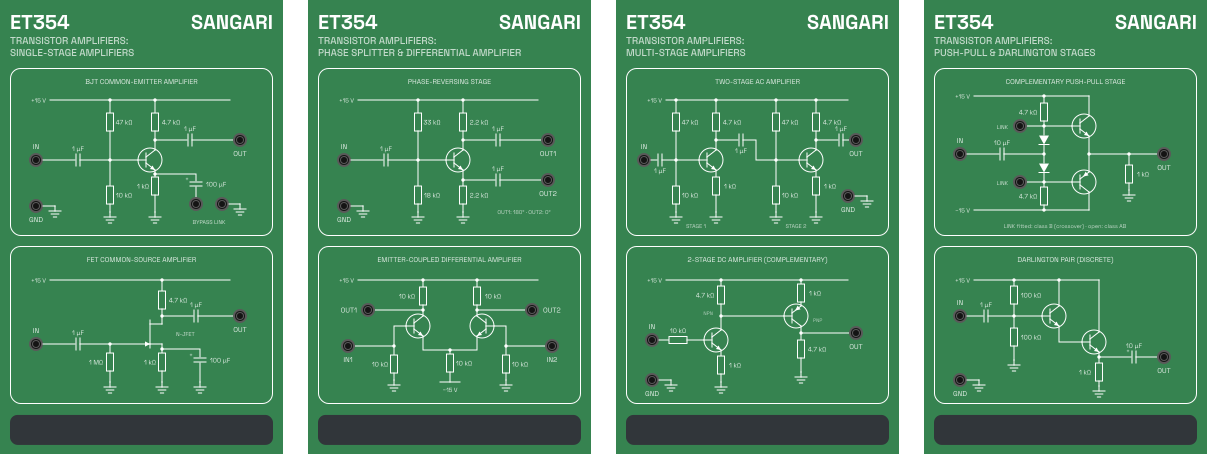
  • Bipolar transistor common-emitter amplifier: operating point, voltage gain, input and output resistance
  • Negative feedback: effect of the emitter bypass capacitor on gain and bandwidth
  • Field-effect transistor (JFET) common-source amplifier
  • Phase-reversing stage with in-phase and inverted outputs
  • Emitter-coupled differential amplifier: differential and common-mode gain
  • Two-stage RC-coupled AC amplifier
  • Two-stage DC amplifier with complementary transistors
  • Complementary push-pull stage: class B crossover distortion and class AB biasing
  • Darlington pair amplifier: current gain and emitter follower
  • Frequency response of amplifier stages with the ET300 Bode plotter
ET354 Single-Stage, Phase Splitter and Differential, Multi-Stage, and Push-Pull and Darlington experiment cards
Description
    The platform teaches discrete transistor amplifier circuits through guided, hands-on experiments. The Single-Stage Amplifiers Card carries a bipolar common-emitter amplifier with voltage-divider bias and a link for its emitter bypass capacitor, and a JFET common-source amplifier with self-bias. The Phase Splitter & Differential Amplifier Card carries a phase-reversing stage with equal collector and emitter resistors and an emitter-coupled differential pair with a shared tail resistor. The Multi-Stage Amplifiers Card carries a two-stage RC-coupled AC amplifier and a direct-coupled two-stage DC amplifier with an NPN and a PNP transistor. The Push-Pull & Darlington Stages Card carries a complementary push-pull output stage with diode biasing - a link removes the bias to show crossover distortion - and a discrete Darlington pair as an emitter follower. Inputs and outputs are on sockets for the ET300 function generator, oscilloscope and Bode plotter. The ±15 V supply comes from the ET300 base system.
Courseware
    The interactive multimedia course combines theory with guided experiments: biasing and the operating point, small-signal gain, input and output resistance, negative and positive feedback, phase relationships, differential and common-mode signals, coupling between stages, power output stages and frequency response. Student answers are evaluated automatically, and the full course - at least 16 hours of directed instruction (4 hours per card) - includes self-assessment.
Scope of delivery
  • Single-Stage Amplifiers Card (BJT common-emitter, FET common-source)
  • Phase Splitter & Differential Amplifier Card (phase-reversing stage, emitter-coupled differential amplifier)
  • Multi-Stage Amplifiers Card (two-stage AC amplifier, complementary two-stage DC amplifier)
  • Push-Pull & Darlington Stages Card (complementary push-pull stage, discrete Darlington pair)
  • Storage case
  • Multimedia course software with course browser
  • Connection cables
Specifications
    Experiment cards Single-Stage Amplifiers Card, Phase Splitter & Differential Amplifier Card, Multi-Stage Amplifiers Card, Push-Pull & Darlington Stages Card
    Devices NPN and PNP bipolar transistors, N-channel JFET, silicon diodes
    Measuring points IN, OUT, OUT1, OUT2, IN1, IN2, bypass and class B links, GND
    Supply Fixed ±15 V from base system, safety extra-low voltage
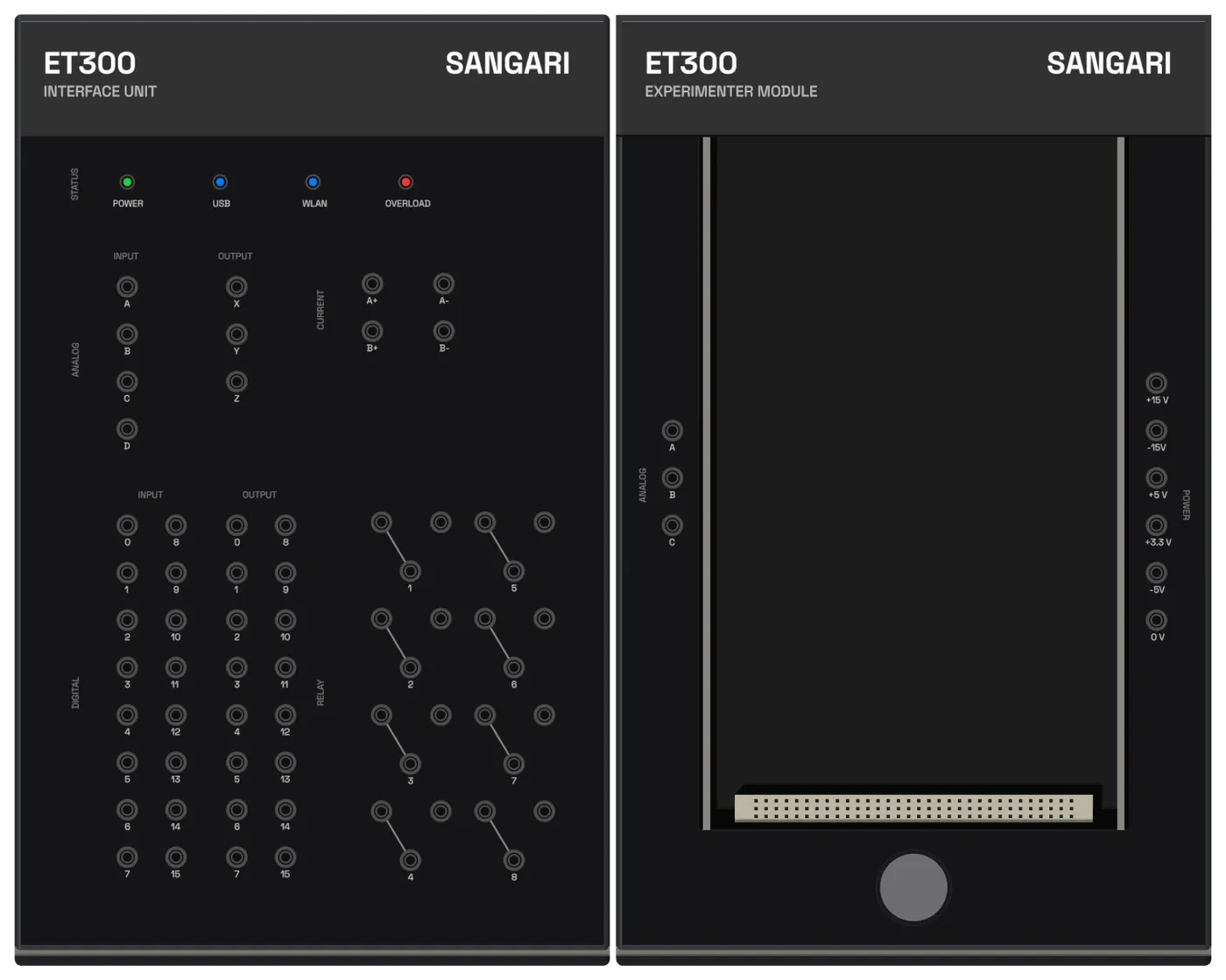
    Measurement ET300 function generator, oscilloscope and Bode plotter
    Course duration Min. 16 hours of guided instruction, with self-assessment
    Base system Requires ET300 (interface + experimenter) - not included

Part of package

Electrical Engineering Training System

A modular electrical-engineering training platform built around virtual instrumentation. The ET300 base system hosts a family of course modules covering three-phase systems, multimeter measurement, network analysis, and sensor measurement technology for non-electrical quantities.