All products

KD716 · Crank Mechanism Experiment
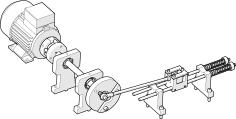
Crank mechanism experiment - vibrations of reciprocating machines

Experiments
  • Vibrations generated by a crank drive - oscillating masses, non-linear kinematics
  • Experimental modal analysis of a reciprocating mechanical system
  • Envelope analysis of shock impacts from bearing clearance
  • Influence of bearing clearance (adjustable 0…1 mm) and piston-rod wear
  • Inconsistent torque characteristic of reciprocating machines
  • Influence of gas forces on the vibration spectrum - springs simulate the gas law (with KD714 or KD715 speed reducers)
  • Transmission of alternating torque through toothed gearing (with KD715)
  • Works together with the KD700 base unit
KD716
Description
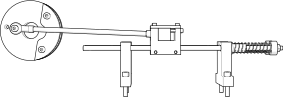
    Compressors and pumps rely on crank drives, whose alternating forces and clearance-induced shocks leave a rich signature in the vibration spectrum. The KD716 experiment reproduces this on a laboratory scale with adjustable stroke, selectable bearing clearance and two pressure springs that stand in for the gas force of a compressor or combustion engine.
KD716 crank mechanism experiment - schematic
Crank disk with adjustable stroke
Connecting rod
Crosshead with adjustable bearing clearance
Pressure spring (gas-force simulation)
KD716 crank mechanism experiment - schematic
Crank disk with adjustable stroke
Connecting rod
Crosshead with adjustable bearing clearance
Pressure spring (gas-force simulation)
Overview
    KD716 front view
Specifications
    Stroke 50 / 75 / 100 mm (interchangeable)
    Balance mass 490 g total, rated for 50 mm stroke
    Bearing clearance adjustable 0…1 mm via interchangeable bushes
    Pressure spring relaxed length 170 mm; stiffness R = 0.55 N/mm (2 supplied)
    Gas-force experiments require speed reduction via KD714 or KD715
    Compatibility designed for the KD700 base unit
    Storage 600 × 400 × 170 mm stackable case with foam inlay
    Weight approx. 8 kg

Part of package

Machinery Diagnostics Lab

A modular training system for vibration measurement and condition monitoring of rotating machinery. Built around the KD700 base bench, it covers rotor dynamics, coupling and bearing faults, belt drives, gears, cavitation, fan and motor vibration through interchangeable experiments.