All products

KD705 · Brake & Load Unit
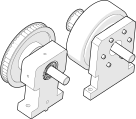
Magnetic-particle brake and load unit for the KD700 machinery diagnostic system

Experiments
  • Vibration analysis of gear systems under load (in combination with KD715)
  • Vibration analysis of belt drives under load (in combination with KD714)
  • Vibration analysis of couplings under load (in combination with KD713)
  • Vibration analysis of electromechanical machines under load (in combination with KD719)
  • Effect of braking torque on the vibration spectrum of a rotating machine
  • Operation across two torque and speed ranges via the integrated belt drive
  • Introduction to the magnetic-particle brake principle and torque control
KD705
Description
    The KD705 generates a controllable braking torque so that vibration phenomena in gears, belts, couplings and electromechanical machines can be studied under realistic load. A vented magnetic-particle brake dissipates the mechanical energy as heat, and an integrated belt drive extends the operating window into two complementary torque and speed ranges.
KD705 brake and load unit - schematic
Integrated belt drive
Shafts - direct and belt-driven
KD705 brake and load unit - schematic
Integrated belt drive
Shafts - direct and belt-driven
Specifications
    Brake type vented magnetic-particle brake with overheating protection
    Continuous braking power approx. 450 W at 3000 min⁻¹
    Direct drive range 200…2000 min⁻¹ at 1…10 Nm
    Via belt drive 600…6000 min⁻¹ at 0.3…3.3 Nm
    Transmission ratio belt drive i = 3
    Torque control potentiometer; exciter current shown on digital display
    Mounting quick precise fixing on the slotted plate of the KD700 base unit
    Power supply 230 V, 50 Hz, single-phase
    Dimensions control unit 460 × 410 × 200 mm
    Weight approx. 30 kg

Part of package

Machinery Diagnostics Lab

A modular training system for vibration measurement and condition monitoring of rotating machinery. Built around the KD700 base bench, it covers rotor dynamics, coupling and bearing faults, belt drives, gears, cavitation, fan and motor vibration through interchangeable experiments.