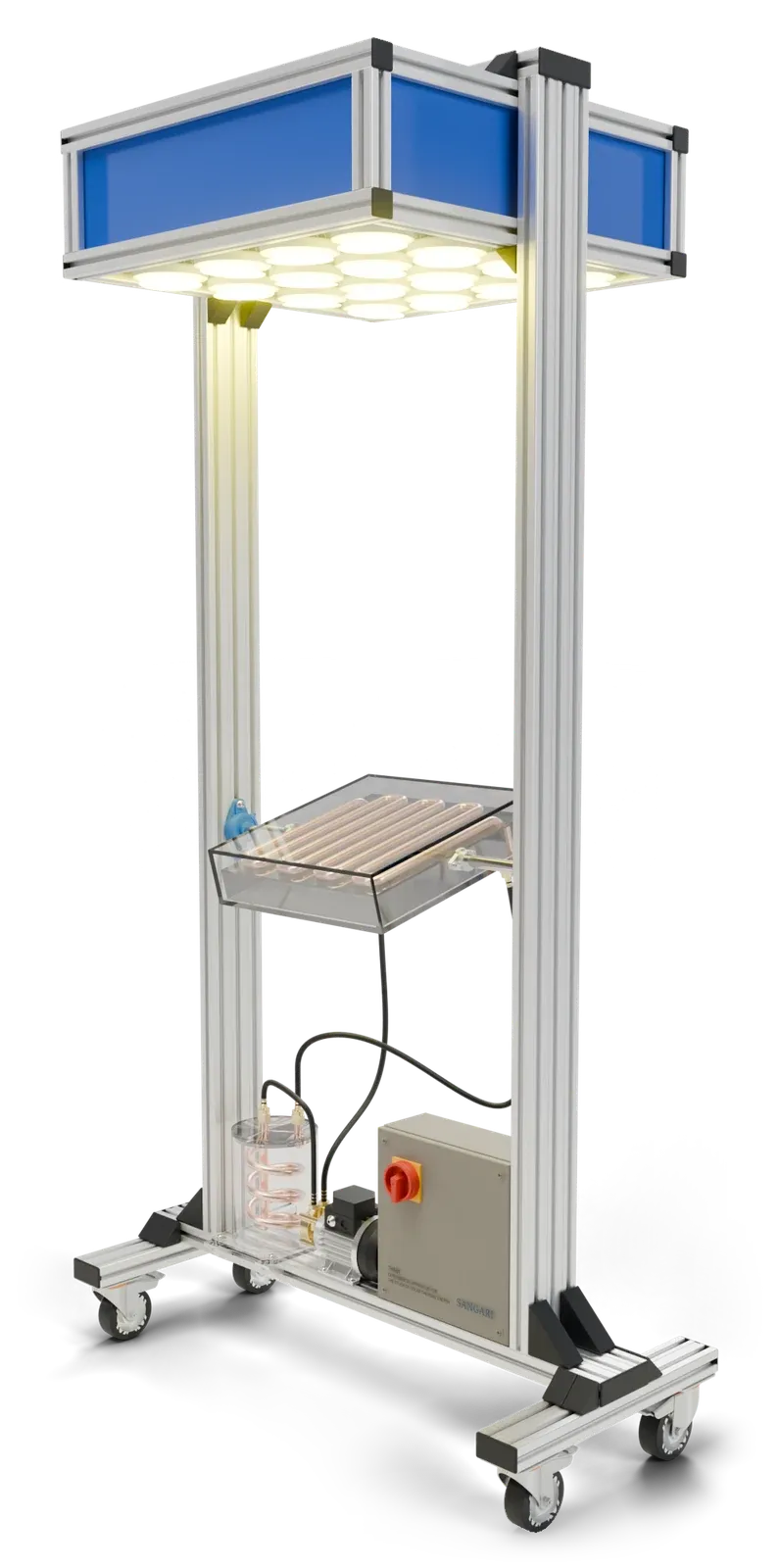
Experimental Apparatus for the Study of Solar Thermal Energy Conversion
A complete, working model of a solar water heating system. Its own lighting unit simulates the sun, so experiments run whatever the weather. Students tilt the flat collector, change the
light intensity and the flow rate, swap the absorber and plot the efficiency curve of the collector from their own measurements.
Description
The TH561 shows how a solar system heats domestic water. It is a complete, working model of a solar thermal system. A lighting unit simulates natural solar radiation, so laboratory
experiments do not depend on the weather. The absorber of the flat collector turns the radiation into heat and passes it to a heat transfer fluid. A pump moves the fluid through the hot
water storage tank, where an integrated heat exchanger passes the heat to the water.
Students set different angles of incidence and different light intensities. The collector comes with a selective absorber, and students replace it with a simpler blackened absorber to
study the losses of the heating system. External consumers connect to the storage tank.
Sensors measure the temperatures in the storage tank, at the collector inlet and outlet and of the ambient air, and a sensor measures the illuminance. The apparatus sends the measured
values to a PC over USB. The supplied software shows the data clearly and analyses it further. Any number of workstations on the local LAN or WLAN network
can follow and analyse the experiment.
230V
170kg
1
Angle adjustment
2
Absorber
replaceable
3
Flat collector
4
Hot water storage tank
with heat exchanger
5
Circulation pump
6
Lighting unit
simulates solar radiation
7
Aluminium profile frame
8
Heat transfer fluid circuit
9
Electrical enclosure
10
Main switch
11
Castors
Main characteristics
complete, working model of a solar water heating system
lighting unit that simulates solar radiation, for experiments independent of the weather
flat collector with adjustable angle of incidence and light intensity
selective absorber, replaceable with a blackened absorber
hot water storage tank with integrated heat exchanger and connections for external consumers
temperature and illuminance readings sent to a PC over USB
analysis software, with the experiment followed at any number of workstations over LAN or WLAN
Technical specifications
Operating environmentuse under laboratory conditions