All products

TH341 · Heat Transfer by Conduction

Experimental Apparatus for the Study of Heat Transfer by Conduction

Learning objectives / experiments
  • Study of linear heat conduction along a bar of uniform diameter, such as:
    • Thermal conductivity by the absolute method
    • Thermal conductivity by the comparative cut-bar method
    • Thermal resistances in series
    • Effect of thermal paste at a joint
    • Thermal lag when the heater power is changed
  • Study of radial heat conduction outwards through a disc of uniform thickness
  • Determination of the thermal conductivity of liquids and gases, after calibration with air as the known medium
  • Comparison of the measured conductivities with published values
  • Recording, calculation and charting of all readings on a computer in real time
TH341
Description
    The TH341 is an experimental apparatus that demonstrates the principles of heat transfer by conduction. It consists of a base unit on which students mount the experimental modules. The base unit supplies the cooling water and the heater power, and it is fitted with the data acquisition and control instrumentation that every module uses.
Main characteristics
  • base unit that supplies cooling water and heater power to every module
  • hand-operated valve for a controllable water flow, with a colour-coded return pipe, so students do not confuse the feed and the return
  • self-sealing quick water connectors, so a module changes over without tools
  • variable and measured heater current, with a safety switch against overheating
  • sockets for the temperature sensors
  • clear multiline digital displays of all temperatures and of the heater power
  • bedplates with a printed schematic of the connections and measuring points, fixed by thumb screws
  • real-time capture, calculation and charting of every reading on a computer
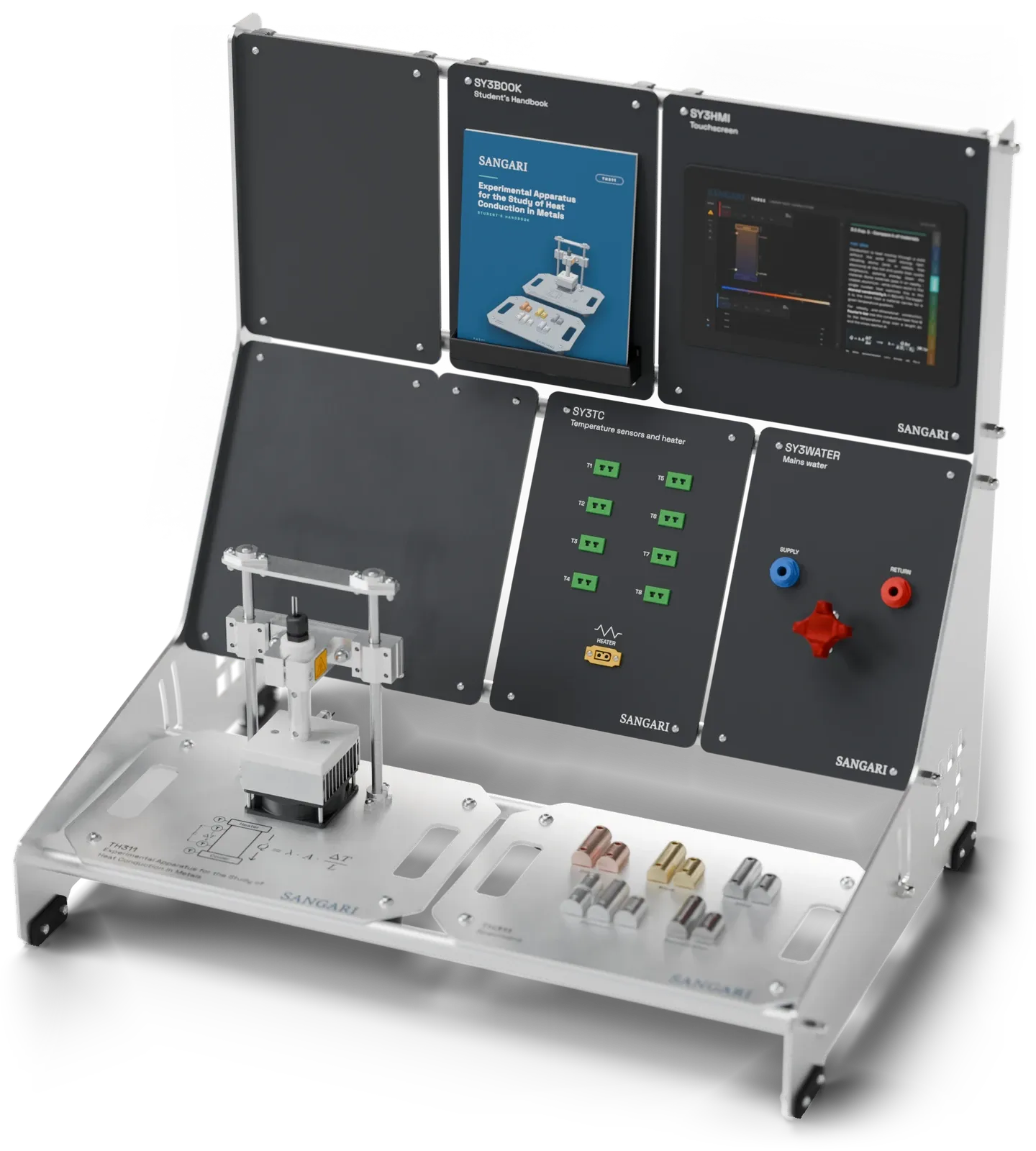
TH341 - the frame with its module panels and the heat conduction experiment
Student’s Handbook holder
Aluminium frame
The module panels clip onto its bars
Experimental module
One of three interchangeable experimental modules
Tilting lower level
Set anywhere from 0 to 15°
Touchscreen
Runs the data acquisition and control software
Temperature sensor sockets
8 sensor sockets and the heater supply socket
Cooling water connections
Quick connectors, blue supply and red return, and a flow control valve
Specimen plate
Metal specimens of different lengths and materials
TH341 - the frame with its module panels and the heat conduction experiment
Student’s Handbook holder
Aluminium frame
The module panels clip onto its bars
Experimental module
One of three interchangeable experimental modules
Tilting lower level
Set anywhere from 0 to 15°
Touchscreen
Runs the data acquisition and control software
Temperature sensor sockets
8 sensor sockets and the heater supply socket
Cooling water connections
Quick connectors, blue supply and red return, and a flow control valve
Specimen plate
Metal specimens of different lengths and materials
Technical specifications
    Operating environment measurements under laboratory conditions
    Power supply 230 V, 50 Hz, single phase, 5 A
    Operating temperature +5…+40 °C
    Operating relative humidity 80 % at temperatures below 31 °C, falling linearly to 50 % at 40 °C
    Maximum supply water pressure 3 bar; clean cold water at 5…15 °C, plus a drain
    Component modules linear thermal conduction module; radial thermal conduction module; conductivity of liquids and gases module; data acquisition system with software for real-time capture, monitoring, display, calculation and charting on a computer
    Heater supply variable and measured, low voltage, with over-temperature safety switch
    Instrumentation temperature sensor sockets and multiline digital displays of temperature and heater power
    Net dimensions W 650 × H 590 × D 480 mm
    Base unit weight approx. 24 kg
    Noise level below 70 dB(A)

Scope of delivery
  • 1 TH341 base unit
  • 3 experimental modules:
    • Linear thermal conduction module, with 4 interchangeable middle sections
    • Radial thermal conduction module
    • Conductivity of liquids and gases module
  • 1 data acquisition system with software and computer cable
  • 1 set of water hoses
  • 1 set of instructional material

All components and accessories listed under Scope of delivery are supplied, whether or not they are visible in the illustrations.

Linear thermal conduction module
    A solid brass bar of circular cross-section, built in two fixed sections with an interchangeable middle section between them. The first section holds the electric heater and two temperature sensors. The second section holds a small water-cooled chamber and two more temperature sensors. Four middle sections of different metals come with the module. Each middle section has three temperature sensors of its own. Insulation around the bar reduces heat loss by convection and radiation.
Middle sections brass, aluminium, stainless steel, copper
Temperature sensors 4 in the bar, 3 in each middle section
Methods absolute method and comparative cut-bar method
Dimensions and weight 390 × 280 × 130 mm, 4 kg
Radial thermal conduction module
    A solid brass disc with an electric heater at its centre as the heat source. A cooling tube around the circumference is the heat sink. Seven temperature sensors sit at equally spaced radii and give the temperature profile as heat flows outwards. Insulation over the disc reduces heat loss by convection and radiation.
Temperature sensors 7, at equally spaced radii
Measured value thermal conductivity of the disc material
Dimensions and weight 390 × 280 × 170 mm, 5.3 kg
Conductivity of liquids and gases module
    Three concentric cylinders. The inner cylinder holds the electric heater, which is the heat source. The test liquid or gas forms a thin cylinder around the heater. A water-cooled outer cylinder is the heat sink. Heat passes by conduction from the source, through the test fluid, to the sink. Temperature sensors read the temperature on the inner and the outer face of the test layer. Insulating end caps reduce heat loss. One end cap comes off, so students clean the module between fluids.
Suitable test fluids dry air, carbon dioxide, castor oil
Dimensions and weight 430 × 280 × 150 mm, 6 kg
Common to every module
  • bedplate with a printed schematic of the connections and the measuring points
  • fixed to the base unit with thumb screws, so students need no tools
  • quick connectors for the cooling water feed and drain
  • safe low-voltage heater with over-temperature cut-out
  • temperature sensors that plug straight into the sockets on the base unit