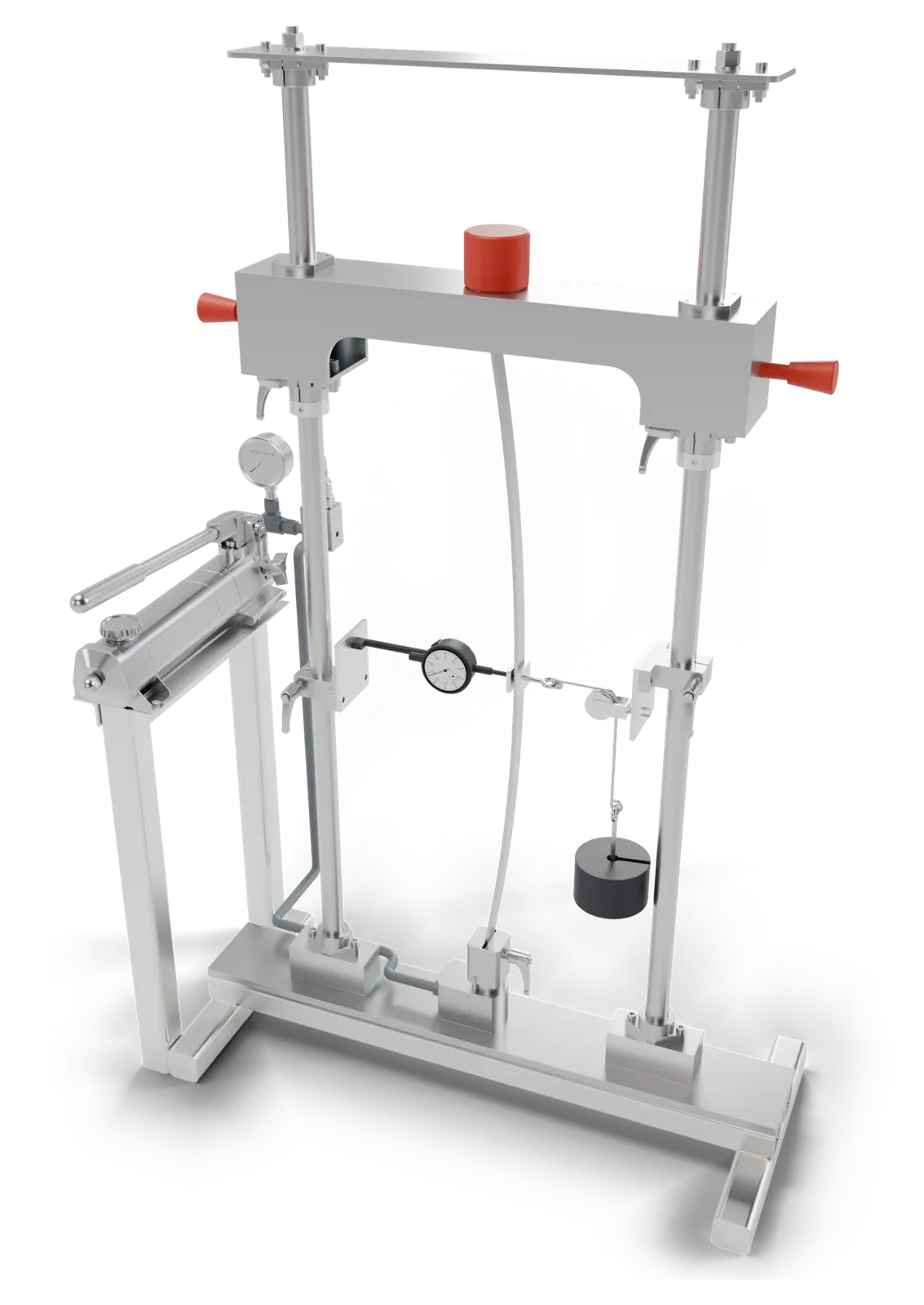
Measuring apparatus for the buckling behaviour of compressed bars
A measuring apparatus for the loss of stability of slender bars under compression. A hand-operated spindle applies a defined axial force to a bar pinned or fixed at both ends; the force is measured hydraulically on a dynamometer and the lateral deflection is read on a dial gauge - so the measured buckling force can be compared quantitatively against the value calculated from Euler's formula. Bar length, cross-section, material and end conditions can all be varied, and a separate mechanism adds a lateral load to study buckling under combined loading.
Experiments
Investigation of buckling behaviour under the influence of:
Different supports and clamps (end conditions)
Different bar lengths and cross-sections
Different materials
An additional lateral load
Verification of Euler's theory - buckling of elastic bars
Calculation of the expected buckling force with Euler's formula
Graphical analysis of the deflection against the applied force
Determination of the modulus of elasticity of an unknown material
Description
The test bar is held in upper and lower supports that can be set as pinned or fixed ends. A hand-operated spindle drives a height-adjustable load member that applies the axial compressive force; the force is sensed hydraulically and shown on a rotatable force gauge, while a dial gauge tracks the bar's lateral deflection. An axial support between the spindle and the bar prevents torsional stress, and a separate mechanism can apply a lateral shear load. The apparatus runs in a vertical or horizontal position.