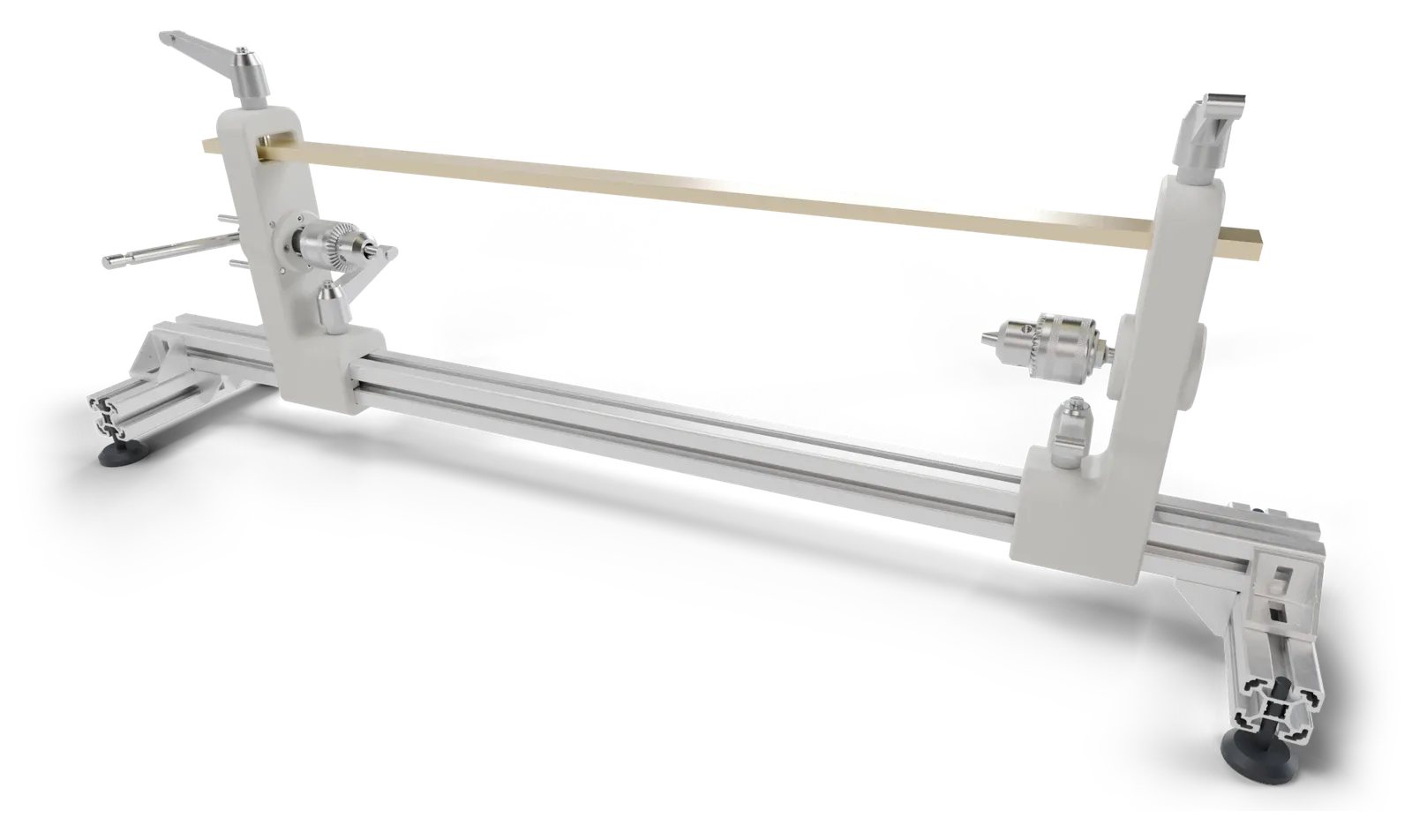
Experimental apparatus for the elastic deformation of bars under bending and torsion
A single benchtop apparatus covers the two elementary load cases of strength of materials. A test bar is held between two movable support blocks and loaded by a hanging weight; in bending the deflection is read on a dial gauge, and in torsion the angle of twist is measured with an inclinometer. By swapping bars of different material, cross-section, length and end conditions, students determine the modulus of elasticity E and the shear modulus G, and derive the proportional relationships that govern deflection and twist.
Experiments
Bending tests:
Determination of the modulus of elasticity E
Statically determinate systems - beam on two supports, cantilever
Statically indeterminate system - two-span beam
Deflection as a function of material, cross-section and span length
Torsion tests:
Determination of the shear modulus G of various materials
Angle of twist as a function of clamping length and bar diameter
Formulation of the proportional relationships for deflection and angle of twist
Description
A test bar is mounted between two support blocks that slide along the frame to set the span or clamping length. For bending, the bar rests on supports (or is clamped at one end) and is loaded by a hanging weight, with the deflection read on a dial gauge. For torsion, a twisting-moment device applies a torque to a round bar held in clamping chucks, and the angle of twist is measured with an inclinometer. Both load cases share the same frame, weights and measuring instruments.