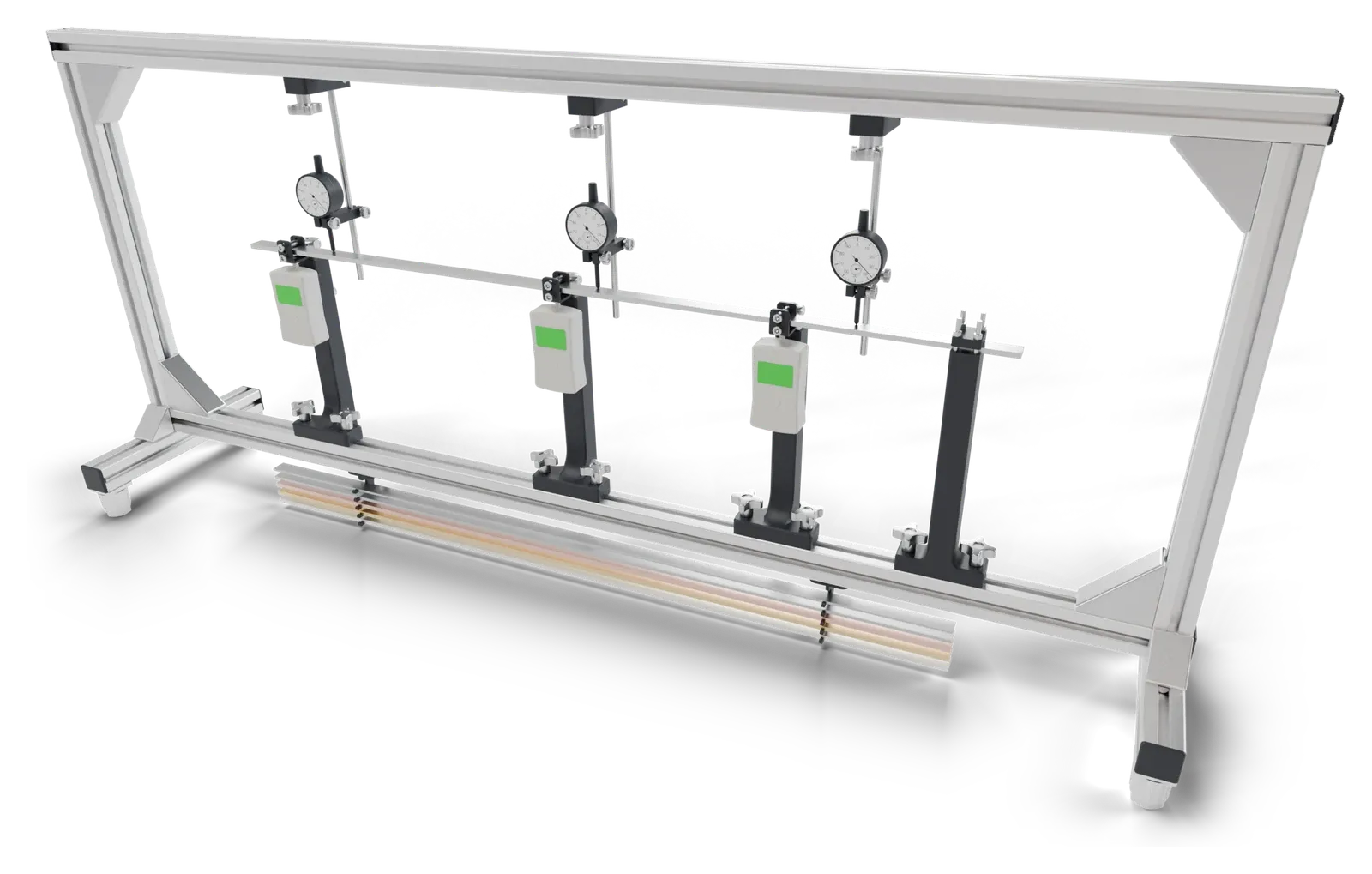
Experimental apparatus for the elastic deformation of straight beams
Beams of different materials and cross-sections rest on articulated, height-adjustable supports fitted with integral force gauges that read the support reactions directly, while dial gauges record the deflection at any point along the span. Reconfiguring the supports turns the same beam into a statically determinate or a statically indeterminate system, so a single apparatus covers the whole syllabus of beam deflection - from the cantilever and single-span beam to multi-span beams, influence lines and the classical energy theorems.
Experiments
Deflection of statically determinate beams:
Cantilever beam - deflection at the load point
Single-span beam on two supports
Deflection of statically indeterminate beams (dual- and triple-span)
Measurement of the support reactions on a multi-span beam
Influence of the material (modulus of elasticity) and the cross-section on the elastic line
Maxwell-Betti reciprocal theorem
Principle of virtual work on determinate and indeterminate beams
Determination of influence lines - arithmetically and qualitatively (Müller-Breslau)
Description
A test beam is supported on a row of articulated, height-adjustable supports mounted in an anodised aluminium frame. Three of the supports carry zeroable force gauges that indicate the support reactions directly, and a fourth support clamps the beam to form a built-in end. Loads are applied with weights on adjustable hooks at any point along the span, and the resulting deflection is read on dial gauges - making both the support reactions and the elastic line measurable on the same setup.
1
Anodised section frame
2
Articulated support with force gauge
3
Spare test beams
4
Dial gauge
5
Test beam
6
Clamping support (fixed end)
7
Levelling feet
Test beams
Quantity5
Length1000 mm
Steel sections3×20, 4×20, 6×20 mm
Brass / aluminium6×20 mm each
Supports & measurement
Articulated supports3 - height-adjustable, integral zeroable force gauge