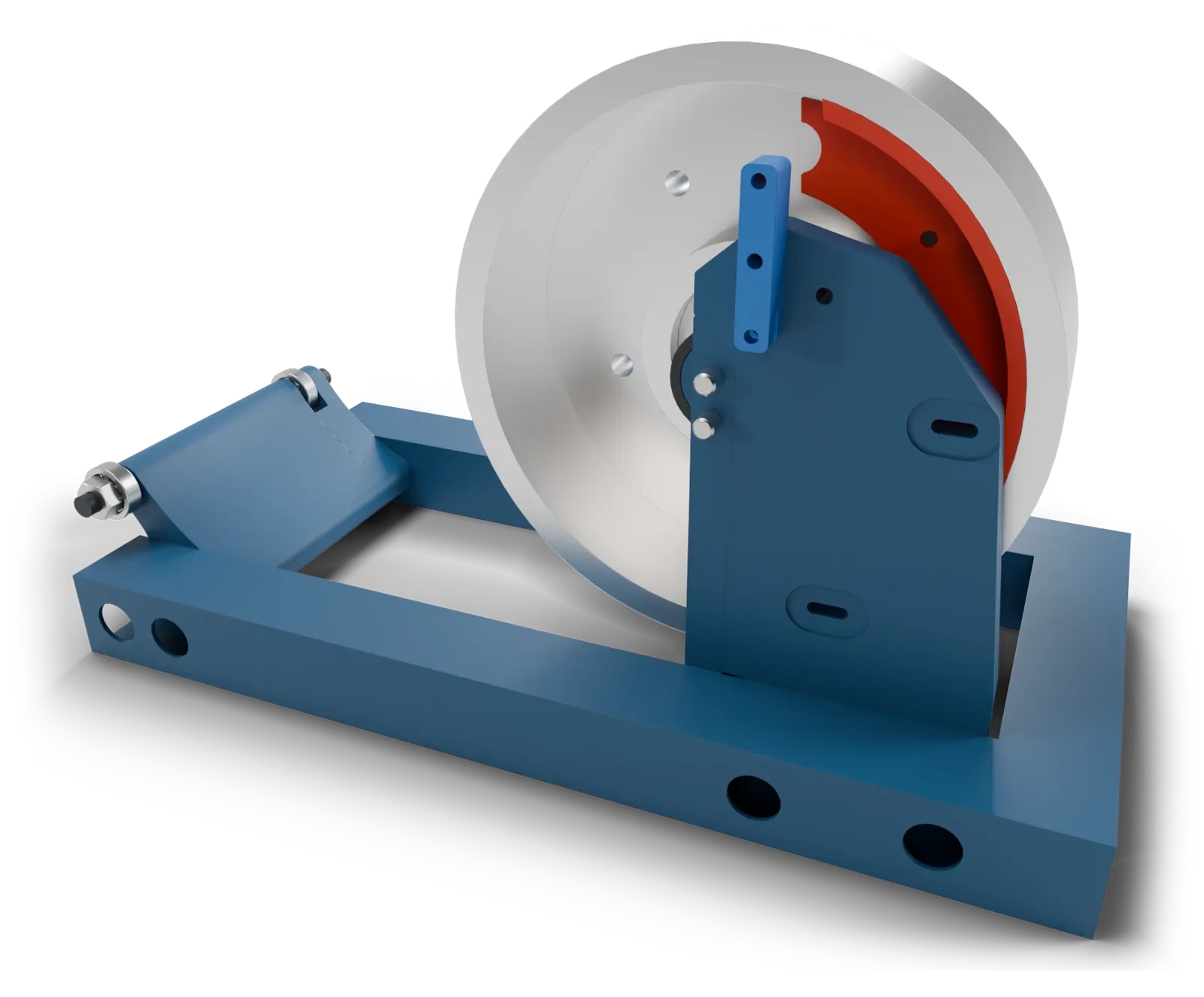
Experimental apparatus for the internal-shoe drum brake
A bench-top model of an internal-shoe drum brake. An aluminium drum is driven by a cord wound around its outer circumference and running over a pulley to a load hanger, while a single pivot-mounted shoe presses against the inner surface under a second cord and hanger. Comparing the driving force with the braking load gives the coefficient of friction between drum and shoe, and reversing the drum's direction of rotation switches the shoe between leading (self-energising) and trailing action - the central idea behind real drum-brake design.
Experiments
Variation of the tangential (driving) force with the braking load
Determination of the coefficient of friction between drum and shoe
Comparison of leading and trailing shoe configurations:
Leading shoe - the self-energising effect
Trailing shoe - the de-energising effect
Influence of the direction of rotation on the braking torque
Description
The apparatus mounts an aluminium brake drum on a rigid vertical support. A driving cord wrapped around the drum's outer groove runs over a pulley to a load hanger and applies the torque that keeps the drum turning. A single brake shoe pivots inside the drum and is pressed against the braking surface by a second cord and hanger, which sets the actuating force. Adding weight to the two hangers and reversing the drum rotation lets students measure the braking action of a leading versus a trailing shoe.