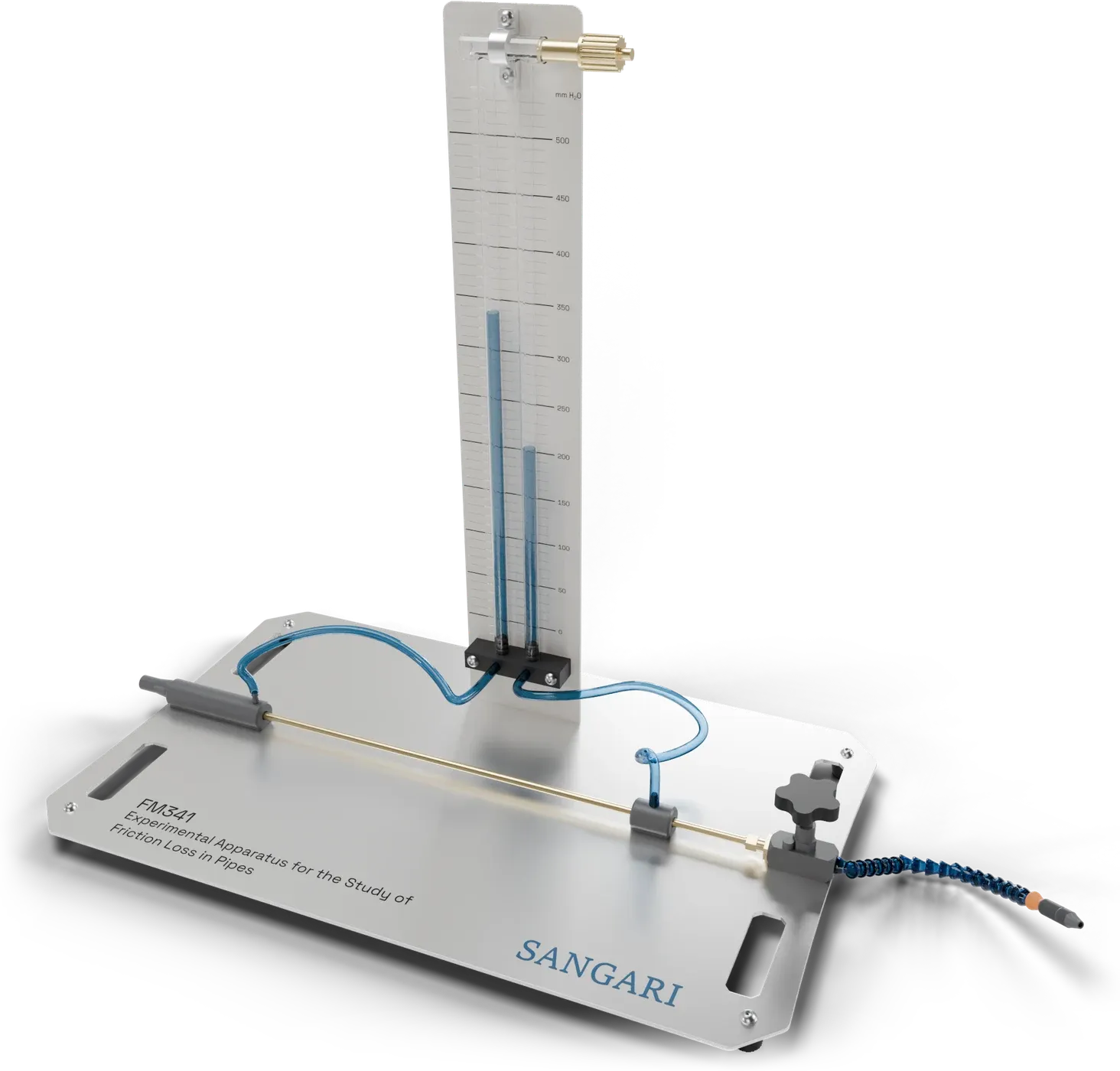
Experimental Apparatus for the Study of Friction Loss in Pipes
Learning objectives / experiments
Study of the friction loss in a pipe
Investigation of laminar and turbulent flow
Measurement of the change in the laws of resistance, the friction factor, from laminar to turbulent flow
Determination of the critical Reynolds number
Demonstration of the transition point of the flow
Verification of Poiseuille's equation and of the coefficient of viscosity of water in the laminar flow region
Determination of the relation between hydraulic gradient and flow velocity, at low and at high flow rates
1
Water manometer
2
Pressure tappings
One at each end of the test pipe
3
Inlet
From the hydraulic bench, through a flexible hose not shown here
4
Test pipe
3 mm ID
5
Air valve
Sets the datum of the manometer tubes, with the hand pump supplied
6
Needle valve
Downstream of the test pipe, for precise flow control
7
Outlet hose to the hydraulic bench
Technical specifications
Operating environmentlaboratory conditions
Operating temperature+5…+40 °C; storage −25…+55 °C when packed
Operating relative humidity80 % at temperatures below 31 °C, falling linearly to 50 % at 40 °C
Test pipenominal internal diameter 3 mm, horizontal on a base plate
Water manometer0…530 mm water, with air valve and hand pump
Flow controlprecision needle valve downstream of the test pipe
Bench connectionhose connector, to the FM500 or any laboratory bench
Net dimensionsW 1000 × H 840 × D 460 mm
Weight12 kg
Data management software
Students record every reading on a PC, in the Sangari eLearning platform. The software plots the hydraulic gradient against the flow velocity, calculates the friction factor and the Reynolds number, and exports the
results for the report.
Scope of delivery
1 FM341 apparatus
1 Header tank for laminar flow
1 measuring vessel
1 thermometer
1 hand pump for the manometer datum
1 data management software licence
1 set of instructional material
All components and accessories listed under Scope of delivery are supplied, whether or not they are visible in the illustrations.